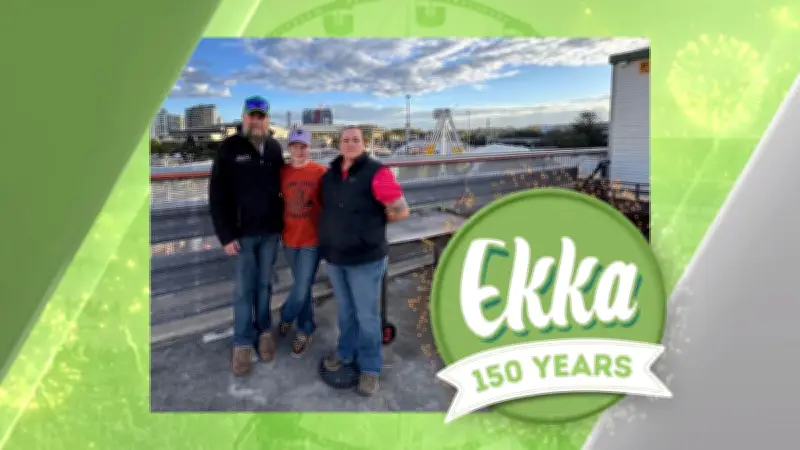
Dozens of Queensland cattle farming families swap their green paddocks for a concrete jungle each year, setting up a temporary village on the rooftop of a Brisbane car park for the Royal Queensland Show, known as the Ekka. Among them are the Cannons from Marburg, who move in about a week before the show opens to the public.
“It really is the country coming to the city every 12 months,” Karla Cannon told 7NEWS.com.au. She has been making the trip since she was about 10 years old.
A rooftop town above the showgrounds
Rows of dongas, tents and mobile amenity blocks transform the top of an ordinary three-storey car park into a temporary town. Below, where cars usually fill hundreds of parking bays, prized cattle are lined up in neat rows for the duration of the show. The sloping vehicle ramps double as washing bays, allowing water and dirt to drain away after the animals are cleaned.
For Anthony Cannon, it is the first time spending two weeks in the rooftop accommodation with his wife Karla and 13-year-old daughter Ella, an award-winning breeder and handler. Looking across to the Royal Brisbane and Women’s Hospital, where rescue helicopters fly overhead, he remembers a journey he never wanted to make.
A recovery and a return to the show ring
Two years ago, Anthony was airlifted to that hospital after a serious T-bone crash left him with a broken neck and multiple injuries. “I didn’t know if I’d walk again,” he said. Today, he is back helping Ella prepare cattle from the family’s Chelna Square Meaters stud, named after their three children — Chase, Ella and Nash.
The family’s award-winning Chelna Cattle Company is among the breeders competing at this year’s Ekka.
Life in a compact donga
The temporary rooftop village sits atop the Brisbane Showgrounds car park. Every level of the concrete structure is filled with livestock — most house cattle, while others are home to goats, poultry and pigeons. Along one side, a conveyor carries hay and fresh bedding to the animals and takes manure back down after exhibitors muck out the stalls.
For Karla, the annual move has become second nature. “We pretty much bring whatever we need to be comfortable,” she said. The family’s donga is simple but practical: in the roughly 3m x 3m room, an air conditioner and a bunk bed are the only furnishings. Each donga is approved to sleep three, but exhibitors must bring their own third bed, so Anthony’s stretcher is squeezed into the remaining space.
An adjoining donga doubles as a makeshift kitchen, with a fridge freezer filled with pre-cooked meals, a camping table topped with a microwave and an air fryer. Shared kitchens allow families to prepare meals together between early starts and late finishes.
Camping in the city
“It’s like camping, really. In the city, we’re camping,” Karla laughed. “This is probably actually better accommodation than what we used to have years ago over in the dungeon, we used to call it.”
Life during the Ekka starts before sunrise. The family’s alarm goes off shortly after 5am, and they head downstairs to muck out stalls, feed and water the cattle, replace hay, wash the animals and prepare them for judging. After breakfast, it’s back to checking cattle, competitions and presentations before feeding again in the afternoon. Evenings are spent sharing a drink with neighbours, reheating a home-cooked meal or heading out for dinner before one final check on the cattle.
Hot showers are a welcome comfort. The portable showers and toilets are cleaned twice a day, with hot water and good water pressure. “Can’t complain,” Karla said.
A community that returns year after year
Between the rows of dongas, a communal area with benches, barbecues and large storage fridges serves as the village’s shared kitchen and meeting place. Friendly rivalries in the show ring are left behind once judging is over, with exhibitors gathering for drinks and catch-ups.
“Everybody’s always got everybody else’s back and it’s a great community to be with,” she said. After years of making the annual move, Karla has learnt a few essentials. “You always need extra power boards because there’s only two power points,” she said. A washing machine is one luxury the family has to leave behind. “So you’ve got to bring enough clothes for the whole time we’re here,” she laughed. “But mainly just keeping it tidy, bringing what you need and don’t overdo it.”
Ella, already an award-winning breeder and handler, continued her success this year, finishing fourth in the parading competition. She spends the week preparing and showing cattle from the family’s Chelna stud, which she has helped break in and care for, before catching up with friends she only sees once a year. “Probably getting to meet up with my friends and show off my cattle to people,” she said.
Once the public arrives, the rooftop village becomes a retreat from the crowds below. “It’s once the public start coming in, it gets very busy and there’s people everywhere,” Karla said. “But between when we come in on Saturday and until Saturday, it’s all of the country people with the cattle that are mainly just here and we get to mingle. It’s not too bad for the first seven days, then the last couple of days it gets really hectic.”
The rooftop accommodation remains off-limits to the public throughout the show, with only exhibitors wearing wristbands allowed back into the top floor of the car park.