The Great Western Hwy has been closed at Victoria Pass since early March, when structural issues were found beneath the road. Transport for NSW said on June 26 that the highway is not expected to reopen until the second quarter of next year, a far longer timeline than the initial estimate of at least three months.
The solution involves building a new road deck on the current alignment above the existing causeway, supported by piles anchored into the bedrock, according to Transport for NSW.
Detour adds hours to travel
All traffic between Mount Victoria and Lithgow has been redirected via the Darling Causeway and Chifley Rd. The detour channels vehicles through local streets not designed for such volumes, adding hours to journeys and increasing safety concerns. Some towns have been completely bypassed, with a flow-on effect for businesses.
For Hartley residents heading east, the trip now requires driving 30 minutes west to rejoin the alternate route, adding an extra hour of detours before the journey even begins.
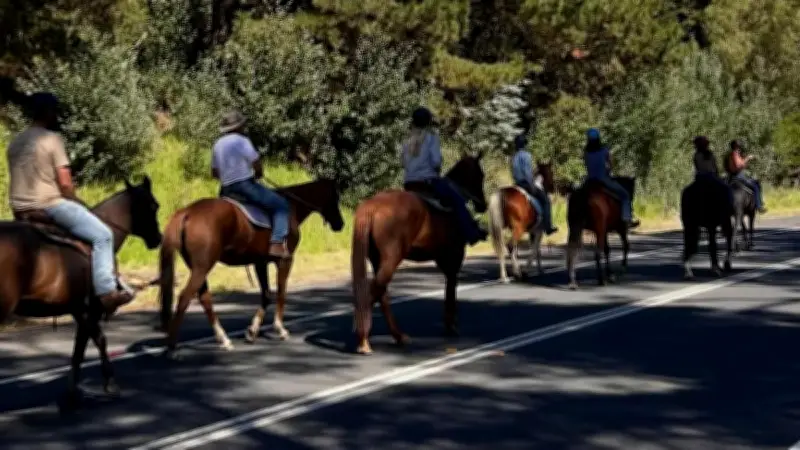
Hartley Valley Holiday Farm, which has been running since the 1970s and offers accommodation, horse riding and dirt bike riding for families, is feeling the closure acutely. Chair Jaime Lumsden said the closure has ended the farm's ability to attract new members, with the detour adding 50 minutes each way to trips. "The highway closure has pretty much ended any meaningful ability that we have to generate new members," she said.
"We have lost some members because it's not convenient for them to come anymore. I think it's added 50 minutes each way to go around the road closure to get to us." Lumsden said some staff had quit due to longer commutes, and the farm was not replacing them because of its uncertain financial position. "It's been incredibly bad timing for us."
Government support package
In late June, the NSW Government announced a $20 million funding package for small businesses "most acutely affected" by the closure. Grants of $10,000 to $25,000 are available to businesses in Mount Victoria, Hartley, Little Hartley and Hartley Vale, while businesses in a wider area including Lithgow, Oberon and Blackheath can receive up to $10,000.
So far, 195 applications have been made to the Great Western Hwy Closure Small Business Support Grant, with 150 approved totalling $2,370,000. Applications close on January 22 next year, or earlier if all available funds are exhausted.
Lumsden said the one-off payments fall far short of what is needed. "That's not even our wages bill for a week," she said. "We have very fixed expenses, there's a limit to how we can cut those expenses." A Business NSW survey from March found 98 per cent of businesses had been impacted or expected to be impacted, with some warning they might close within three to six months without assistance.
"There has to be something more... $5,000, $20,000 as one-offs are not going to cut it for a lot of these businesses," Lumsden said. "For 12 months, ongoing support of some kind is what's going to be needed, or businesses will just dissipate."
The NSW Government acknowledged the "ongoing challenge" the closure presents for local businesses. "That is why an additional $20 million funding package was announced in June... We will continue to monitor the impact on local trade as recovery works progress," it said.
Heritage inn feels the pinch
Steve Warren, owner of the heritage-listed Collits' Inn, a wedding and functions venue, described the closure as "horrible". The inn, which is more than 200 years old and the oldest standing building in the Blue Mountains, has seen a surge in traffic past its door. "There's been more traffic in the last six months than (the inn's) probably seen in the last 60 years," he said. "Our public events have obviously slowed down dramatically."
Warren said he has received no direct communication from authorities, apart from a visit from Service NSW. "I've got to go out and actively find it all myself," he said. He also raised concerns about the Scenic Hill detour in Lithgow, a 3km stretch with a 375m vertical rise and a 1:8 gradient that all highway traffic, including heavy vehicles, must climb. "When there is something that goes wrong on that hill, there is zero contingency. There's no other way."
The influx of detoured traffic through Lithgow's streets is also making daily life difficult for locals. "Traffic through Lithgow is just ridiculous. People can't get to the shops, they can't get up the street, they can't get to their appointments," Warren said. "If I was living in Lithgow, I'd just be dreading if I had to duck up the street and get a loaf of bread."
With no fixed reopening date, businesses face months of uncertainty. Lumsden said the extended closure could permanently change the character of the community. "The idea that this place might not be there for people like my daughter and other kids at the farm... is a very, very sad thought. Even if we survive, the idea that some of the community that we're used to might not be there for us... You think about what else is going to go, what else won't survive. How is it going to change the character of the community? That's very sad."